Thursday, March 8, 2012

Dog Fence for your Pets


Dogs love to wander and play in an open space. They love to run freely and explore places in their own ways. Many of these dogs typically find ways to get out of fenced areas and other containment. As pet owner, we want only the safety for our pets. 


The idea of containing them using chore or chain link fence may be quite expensive for you. But there’s good news, as the technology advances there’s also new methods or devices out in the market to contain your dog in a specific area. One of the best options you have is the modern electric dog fence that works effectively and is very easy to use.

You don’t have to worry about the installation; you just need to find a proper perimeter where your dog can stay in, some professional companies took care of the installation. Sensors are placed around the fenced area that interacts with the specialized dog collar used for the fence. The collar will then beep to warn your dog whenever it gets too close to these sensors. Dogs will receive a slight shock in response which they don’t want this kind of feeling. But don’t worry; dogs are known to be the fast learner animals, after two or three shocks they will learn to get off from the sensors whenever they hear the warning beep.

Other people consider this method as inhumane because they really don’t understand the benefits of it. In fact, electric dog fence were made completely pet friendly.  You’re the one who will set the shock level with the shock setting on the collar. The shock is meant to surprise and not to cause pain. It doesn’t really hurt your pet at all; it works by startling the dog.

Nowadays, more and more pet owners are switching to an electric dog fence to contain their dog due to its low cost and ease of setting up. Most electric dog fence owners also have been enjoying the benefits of their fence for years.

You can also use and enjoy these devices in any space you want to let your dog to run free. The electric dog fence is modern, effective and quite easy to use. You can also ensure the safety of your pets.

Visit http://www.petstreetmall.com/dog-fence/ for more dog fence selection.

Thursday, February 9, 2012

Accidents May Happen...

Your puppy is bound to make mistakes, especially in the first few weeks of house training. Always remember that he is just a baby - no matter what his size and that he needs time to learn. You are his teacher, and he relies on you to make sure that he gets plenty of opportunities to do things right.

If your pup pees or poops in the house, don't yell at him. Instead, make a not to yourself to watch him more closely and take him out more frequently. Then gently put him in his crate or the safe room, and clean up the mess. Remember: reward correct behavior and ignore unwanted behavior.


Never rub his nose in the mess or swat him with a rolled up newspaper, or anything else. Not only will anger and punishment increase stress and fear in your puppy, but he'll also become sneaky about finding places to potty.

If you watch your puppy in the act of eliminating in the house, clap your hands to get his attention and, say, "Aaaaght Outside". If he stops (unlikely), take him outside to finish. Avoid saying "NO" or calling him a bad dog. You don't want him to think that the act of eliminating is wrong, you must want him to know that he chose the wrong place.


Until your pup is reliable, don't let him run free in you home. A puppy who is eliminating everywhere in the house has too much freedom. Instead, keep him by your side or confined to his safe room or crate. This is especially important during busy times of the day such as mornings and dinnertime, when you have less time to watch him. It is important to restrict his access to certain areas within the house until he starts eliminating outdoors on a regular basis.

Part of house training is being able to read your pup's cues. Dogs have different ways of letting you know when they need to go out. Some dogs bark or run to the door, but others are subtle in their communications, which they limit to staring or twitching their ears a certain way. Many dogs learn to ring a bell on the doorknob or on the wall next to the door. Be sure it's within your pup's reach. Every time you take him out for a potty run, ring the bell before you go out the door. When he rings the bell on his own, praise him and take him out. Whatever the sound of behavior, watch your pup closely to learn his signals.

If you're having problems house training your puppy, make sure you're being consistent with your training methods. Don't try method after method, quickly switching from one to another. Choose the method you want to use, and stick with it. Otherwise, your pup will become confused. Keep in mind, too, that house training accidents - specially after a pup seems reliable - may indicate a health problem. Take your puppy to a veterinarian for an exam if he suddenly breaks house training for no apparent reason. He may have a bladder or kidney infection.

Wednesday, February 8, 2012

What Goes in Must Come Out

Another way to help your puppy potty on schedule is to feed her at set times each day rather than leaving food out and allowing her to nibble all day long. When yours dog eats at the same time every day, its easier to gauge when she'll need to go out. Feed your young pup after her first elimination of the day, once in mid afternoon, and again in the evening, spacing her meals about six hours apart. Feeding your pup high-quality, highly digestible food helps keep her on schedule as well. The ingredients in these foods produce less too volume, meaning your puppy won't have to eliminate as often.


Eating stimulates your pup's bowels, so take her outside after meal. Give her a couple minutes to do her business and if she doesn't potty, take her back inside and crate her so that she doesn't potty in the house. Try again in ten minutes. Keep taking her out at ten-minute intervals until she performs, paying attention to the amount of time that elapses between the end of the meal and when she finally potties. Most pups need to to thirty to sixty minutes after eating. If you know your pup's needs, you can keep her on schedule and avoid accidents.

Thursday, January 12, 2012

Preventing Potty Problems

Watching your puppy when he's outside place is crucial. If you don't watch him, you won't be able to prevent accidents. A good way to keep your puppy from wandering off and having an accident while your back is turned is to leash him and keep him at your side. He'll enjoy being with you, and you'll notice immediately if he needs to go out. Give him a toy to play with while he's next to you. If you're doing something that doesn't allow you to keep a close watch on your puppy, put him in his crate, playpen, or safe room. this will help prevent any accidents.

Every time you notice your puppy sniffing, circling, or squatting, clap your hands to get his attention and say "Outside? Do you need to go outside?" Then hustle him out before he has a change to do anything. Set a timer so that you remember to take him out every hour or two, even if he doesn't show any signs of needing to go out. Always take your pup out on a leash so you can see him potty, and praise him when he does. Giving a small food reward, such as a bit of kibble, immediately after your pup potties further reinforces the habit of eliminating outdoors.


Consistent positive reinforcement is the key to successful house-training.

It's very important that you go outside with your puppy. If you aren't there with him, you can't praise him for eliminating or teach him to go potty command. You also have no way of knowing whether he actually did anything. Many pet owners get angry because they send their pup outside and then the pup pees or poops when he comes inside. Without your guidance, your pup doesn't know why he's outside. If he hasn't performed after fifteen or twenty minutes, take him inside and crate him. Try again later.

Wednesday, January 4, 2012

Reward Performance

After your puppy eliminates, say, "Good Potty!" or something else that comes across as praise. Choose any short phrase that works for you, and say it in a happy, approving tone of voice. When you assign a name to the action, your puppy learns to associate the word with the act and may learn to go on command. Just don't make the mistake one owner did of using the phrase "Good dog" or your pup will start going potty every time you praise him, whether you meant him to or not. Make sure everyone in the family knows the key phrase for going potty and uses it consistently. You don't want your puppy to become confused.


Speed up the training process by making potty time pleasant for your puppy. Keep some tiny treats in your pocket so you can reward him the instant he's through eliminating (don't interrupt him before he's finished). Then, spend a few minutes playing. He'll soon learn that the quicker he does his business the sooner playtime comes. This is useful on rainy days or when you're in  a hurry.

Thursday, December 22, 2011

It's Cold Outside. Can I Paper-Train Her First?

Most trainers agree that teaching a puppy to go on paper and then retraining her to go outside can be confusing. Some dogs never quite figure out that they are supposed to move on from papers to the great outdoors and continue to potty on any pile of papers they see.


One puppy who had been reliable in the house for some time had a relapse one day when her owners were painting the hall. They had laid down papers to protect the carpet, and she came along and squatted on them for a quick pee. They hadn't paper-trained her at all, but apparently, the breeder had laid down papers to protect their floors and the smart pup remembered what they were for. But if you live in a high-rise building or are unable to walk your dog regularly, try paper-training or litter box training.

To paper-train your dogs, spread a few layers of paper in the area you want your pup to go. Then, instead of taking her outside, take her to the papers. Let her sniff around, but if she moves off the papers, set her  back on them. When she eliminates, praise her.

If you're having trouble getting your pup to use the papers, try this trick. When she urinates, hold a sponge underneath the flow to capture some of the urine. You can then use the sponge to scent the papers. The next time you take your pup to the papers, she'll smell the urine and remember what she's supposed to do. You can also purchase pads at pet supply stores that claim to induce eliminating. When the pad is placed on the papers its scent is supposed to encourage a puppy to eliminate there. It's worth a try if you're having problems.

To house-train your dog with a litter box instead of papers, follow the same process as paper-training. Litter boxes and litter suited for puppies and dogs who weigh up to thirty-five pounds can be found in pet supply stores. Shredded paper, which some dogs prefer, can be substituted for litter.

Wednesday, December 14, 2011

How Do I House-Train my Puppy?

Start house-training your puppy as soon as you get him home. Even before you bring him into the house for the first time, take him to the potty spot you've chosen, and let him sniff around. Make note of any patterns of sniffing, circling, and squatting. These are his clues that he needs to go out. If he performs, praise him in a happy tone of voice, "Good Potty!" Then take him inside, and introduce him to his special place, which can be a crate or anything.

Dog develop preferences for certain potty surfaces, usually based on what they learn as a puppy. It's a good idea to expose your pup to different potty surfaces such as asphalt, concrete, and gravel so that if you don't have access to grass, you won't have a problem getting him to go.


Young puppies should not have the run of the house. Before you bring your puppy home, choose a safe area of the house to let your pup stay. This is usually a kitchen, laundry room, bathroom or some other area with an uncarpeted floor. Rooms with tile, vinyl, or concrete floors are good choices.


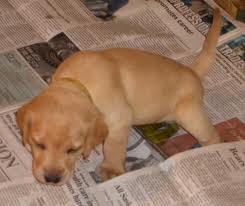
Lay down papers in this rooms (this is not paper-training but simply an easier way to clean up messes). Put your pup's open crate, a couple of chew toys, and a food and water dish at the opposite end of the room. Close off the room with a baby gate or other barrier to prevent him from wandering throughout the house. Until your puppy is house-trained, he need to be under your direct supervision or confined to an area where he can't get into trouble.

The goal is for your pup to eliminate away from his crate and eating area whenever you aren't there to take him out. Once your pup is consistently eliminating in a certain spot on the papers, you can gradually take up the papers, leaving only the favored area covered.

If you come home and your pup has pottied in the safe room, don't scold him. He's just doing what comes naturally. Take him outside and praise him when he potties in the chosen spot. If you take him to the same area every time, the lingering scent will prompt him to go again.